
Are You Still Trying to Run Large Data Workloads on Your CPU?
Scalium
>
Insights
>
Blog
>
Are You Still Trying to Run Large Data Workloads on Your CPU?
If your enterprise relies on CPUs to prepare data for AI, you are likely losing 50% of your compute investment to a physical bottleneck.
Modern AI infrastructure requires massive parallel throughput. Yet, most organizations still force their data through serial CPU pipelines before it ever reaches the GPU cluster. This is a fundamental architectural error. It prevents AI from reaching production scale.
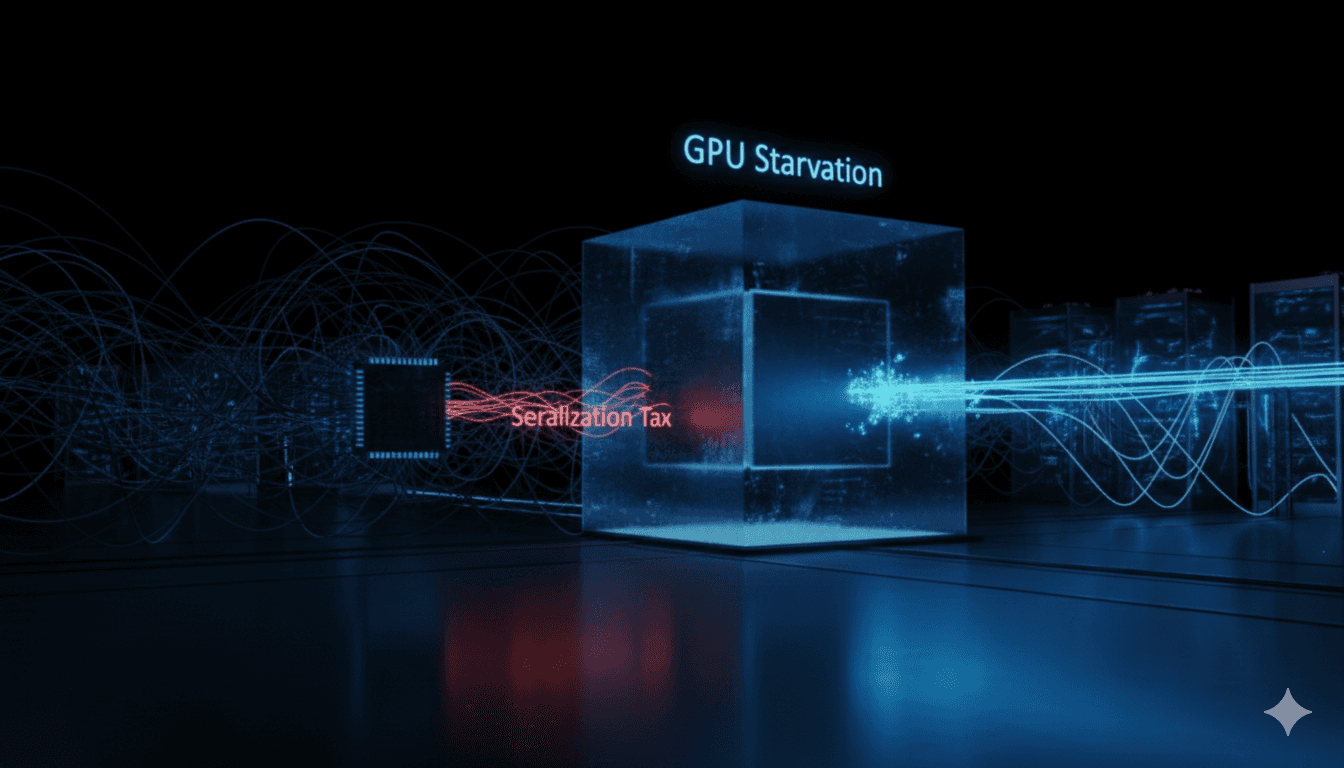
This is called The Serialization Tax. If you run high-volume ingestion, transformation, or curation on a CPU, you pay that tax in the form of idle silicon and wasted power.
The Physics of the Bottleneck
The problem is one of Impedance Incompatibility.
CPUs are designed for serial execution. They process logic and data in a specific, one-after-another sequence. GPUs are designed for massive parallelism. They require thousands of data points simultaneously to saturate their cores.
When you use a CPU-bound pipeline to feed a GPU, the CPU becomes a physical throttle. It cannot move, transform, or vectorize data at the velocity the GPU demands. This results in GPU Starvation - the state where your most expensive assets sit idle, drawing power while waiting for the next data packet to arrive.
Moving the Full Lifecycle to the GPU
Stop treating the GPU as a destination. Treat it as the primary engine for the entire data lifecycle. SCAILIUM is the AI Production Layer that makes this possible.
We enable you to move these workloads entirely onto the GPU:
Ingestion: Stream raw data directly into VRAM.
Transformation: Execute complex ETL and data cleaning in parallel.
Curation: Filter and label datasets at production speed.
Injection: Feed the model without CPU round-trips.
By executing the dataflow natively on the GPU, SCAILIUM eliminates the "hop" between storage and compute. This results in Silicon Saturation, where your clusters operate at 80% utilization or higher.
Case Study: Real-Time Cybersecurity at Scale
Consider the architecture of a global cybersecurity provider. To detect sophisticated threats, the system must analyze billions of raw network logs in real-time.
The CPU Approach: CPUs cannot handle the sheer volume of logs in real-time. The organization is forced to use data sampling. They only analyze a fraction of the traffic. This creates Visibility Gaps, where attackers hide in the unexamined data.
The SCAILIUM Approach: By moving the pipeline to the GPU, the organization processes the Full-Fidelity dataset.
Vectorization: The GPU converts raw logs into numerical arrays (tensors) at 10x the speed of legacy systems.
The security model sees everything. There is no sampling. The result is a more resilient defense system that operates at the speed of the network, not the speed of the CPU.
Managing Production-Size Data in One Place
Fragility in AI systems stems from fragmentation. Moving data between different tools for ingestion, vectorization, and training creates latency. It increases the surface area for failure.
SCAILIUM provides a single, GPU-native software backbone. You manage the entire pipeline in one environment. You work with production-size data from day one. This ensures that a model built in development performs when exposed to the high-velocity data of a live production system.
The Economic Reality: Throughput Per Watt
For a technology executive, the shift from CPU to GPU-native pipelines is a matter of capital efficiency.
An idle GPU cluster is an energy drain. It draws significant wattage even when it is not performing work. By eliminating the CPU bottleneck, SCAILIUM shortens job durations. It increases your Throughput Per Watt (TPW).
TPW: A metric that defines how much intelligence is produced for every unit of electricity consumed.
Maximized TPW allows you to scale your AI capabilities within your existing power and cooling limits. You effectively double your usable compute capacity without purchasing more hardware.
From Legacy Manager to AI Factory Architect
The transition from CPU-centric data centers to GPU-native AI Factories is the most significant shift in digital infrastructure this decade.
Continuing to rely on CPU workloads for AI is a choice to remain in the legacy era. By adopting SCAILIUM, you align your infrastructure with the physics of modern silicon.
You enable your business to process data at its true scale. You turn your data center into a high-velocity production system. You become the champion who solved the starvation problem and unlocked the true ROI of the AI investment.
